









The ultimate guide to digital transformation for Singapore SMEs (2026)

Running an SME in Singapore has never been more challenging. At the same time, the opportunities for growth have never been greater.
Businesses today are navigating rising operating costs, ongoing labour shortages, increasing customer expectations, and growing competition from digital-first companies. Customers now expect fast responses, seamless online experiences, flexible payment options, and personalised services regardless of whether they’re buying from a multinational corporation or a local SME.
At the same time, the Singapore Government continues to encourage businesses to embrace digitalisation through initiatives such as SMEs Go Digital, the Productivity Solutions Grant (PSG) and the Enterprise Development Grant (EDG). These programmes are helping thousands of SMEs invest in technology that improves productivity, strengthens cybersecurity, and supports long-term growth.
However, digital transformation is much more than buying new software or moving files into the cloud. True transformation involves rethinking how your business operates, serves customers, and makes decisions. It’s about creating more efficient workflows, empowering employees with better tools, and building a business that can adapt quickly to changing market conditions.
Whether you’re just beginning your digital journey or looking to take your existing systems to the next level, having a clear strategy is essential. Without one, businesses often end up with disconnected software, duplicated work, and technology that creates more problems than it solves.
This comprehensive guide explains what digital transformation really means, why digital transformation is becoming increasingly important for Singapore SMEs, the areas of your business that can benefit most, and the practical steps you can take to build a successful digital transformation roadmap.
What is digital transformation?
Digital transformation is more than just tech. It’s about changing how your business works.
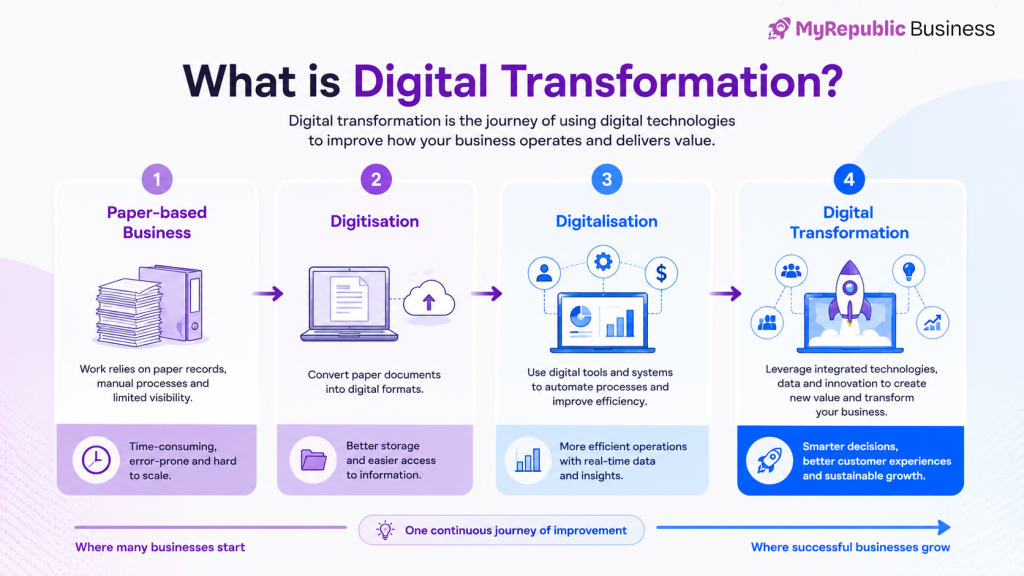
The phrase “digital transformation” is often used interchangeably with terms like digitisation and digitalisation, but they are not the same thing. Understanding the differences can help businesses make better investment decisions.
Although these terms are closely related, they represent different stages of a business’s digital journey. Here’s what each one means and how they contribute to digital transformation.
Stage 1: Digitisation
Digitisation is the process of converting physical information into digital formats.
Examples include:
- Scanning paper invoices
- Saving contracts as PDFs
- Digitising employee records
- Moving paper forms into digital files
Stage 2: Digitalisation
Digitalisation involves using digital tools to improve existing business processes.
For example:
- Using cloud accounting software instead of desktop software
- Implementing an online booking system
- Managing payroll through a HR platform
- Accepting digital payments
Digitalisation improves efficiency but often focuses on individual departments rather than the business as a whole.
Stage 3: Full digital transformation
Why many SMEs misunderstand digital transformation
In reality, buying software without changing workflows often leads to:
- Duplicate data entry
- Poor staff adoption
- Fragmented operations or disconnected teams
- Increased operational complexity
One of the biggest reasons for poor adoption is that employees are forced to work around the new software instead of with it. If existing processes remain unchanged, staff may find themselves switching between multiple systems, manually re-entering information, or following cumbersome workflows that feel slower than before. Over time, they may revert to familiar methods such as spreadsheets, emails, or paper-based processes, preventing the business from realising the full value of its technology investment.
Successful digital transformation starts by identifying operational challenges before selecting technology that supports improved ways of working.
Key takeaway: Technology alone rarely solves business problems. Digital transformation involves changing business processes, not simply the technology you use
Why is digital transformation important for Singapore SMEs?
1. Improving productivity amid manpower shortages
2. Meeting changing customer expectations
- Fast responses
- Online purchasing options
- Digital payments
- Self-service portals
- Personalised communications
Businesses that fail to meet these expectations risk losing customers to competitors that offer more seamless digital experiences.
3. Supporting hybrid and flexible work
Cloud-based systems enable employees to access files, collaborate securely, and continue working regardless of location.
This flexibility improves business continuity while supporting modern workplace expectations.
4. Strengthening cybersecurity
As businesses become more digital, cyber threats continue to evolve.
Ransomware, phishing attacks, and data breaches can cause significant financial and reputational damage, particularly for SMEs with limited IT resources.
Building cybersecurity into digital transformation ensures businesses can grow without exposing themselves to unnecessary risk.
5. Staying competitive in a digital economy
Singapore continues to position itself as a leading digital economy within Southeast Asia. Businesses that invest in digital capabilities are often better positioned to expand regionally, respond to market changes, and innovate more quickly.
6. The benefits extend across the organisation
Digital transformation can deliver measurable improvements including:
- Higher productivity
- Reduced operating costs
- Faster decision-making
- Improved customer satisfaction
- Better employee experiences
- Increased operational resilience
- More scalable business growth
Rather than replacing people, technology enables employees to work more efficiently while giving business leaders greater visibility into their operations.
What areas of a business should be digitally transformed?
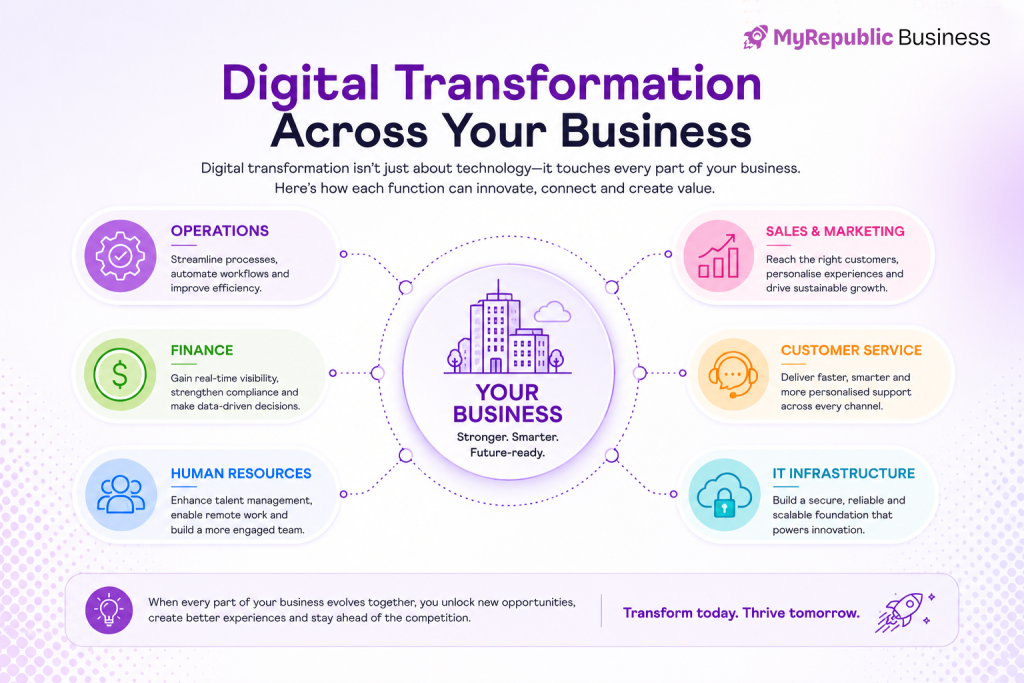
Digital transformation is rarely confined to a single department. The greatest value comes when improvements are made across the organisation and connected through integrated systems.
Streamline daily operations and improve efficiency
Operational efficiency is often the first area SMEs focus on when embarking on digital transformation.
Common initiatives include:
- Workflow automation
- Digital document management
- Inventory tracking
- Electronic approvals
- Automated notifications
Replacing manual processes with automated workflows reduces errors, shortens turnaround times, and improves accountability across the business.
Simplify financial management and gain real-time visibility
Finance teams benefit significantly from cloud-based systems that streamline day-to-day financial processes.
Digital finance tools can automate:
- Invoicing
- Expense management
- Bank reconciliation
- Financial reporting
- Payment reminders
With real-time visibility into business finances, owners can make faster, more informed decisions while improving cash flow management.
Improve sales, marketing, and lead generation
Digital transformation enables businesses to better understand customer behaviour and improve lead generation.
Common solutions include:
- Customer Relationship Management (CRM)
- Marketing automation
- Email marketing
- Website analytics
- Social media management
- Sales reporting
Instead of manually tracking customer interactions across multiple systems, businesses gain a complete view of each customer’s journey, enabling more personalised engagement and informed sales decisions.
Deliver faster and more responsive customer service
Customers increasingly expect timely, convenient support across multiple channels.
Digital customer service solutions include:
- Live chat
- AI-powered virtual assistants
- Online knowledge bases
- Helpdesk ticketing systems
- Customer portals
These tools improve response times, increase service consistency, and enable support teams to handle larger enquiry volumes more efficiently.
Modernise HR processes and enhance the employee experience
Digital tools help HR teams reduce administrative workloads and improve the employee experience throughout the employee lifecycle.
- Digital payroll
- Leave management
- Recruitment systems
- Employee onboarding
- Performance management
By automating routine administrative tasks, HR teams can spend more time supporting employee development and business growth.
Build a secure and scalable IT foundation
A modern IT foundation supports every aspect of digital transformation.
Key investments include:
- Business broadband
- Cloud infrastructure
- Managed IT services
- Secure remote access
- Cybersecurity
- Backup and disaster recovery
Reliable connectivity, secure infrastructure, and resilient IT systems provide the foundation businesses need to support future growth, protect critical data, and adapt to changing business requirements.
How to build a digital transformation strategy
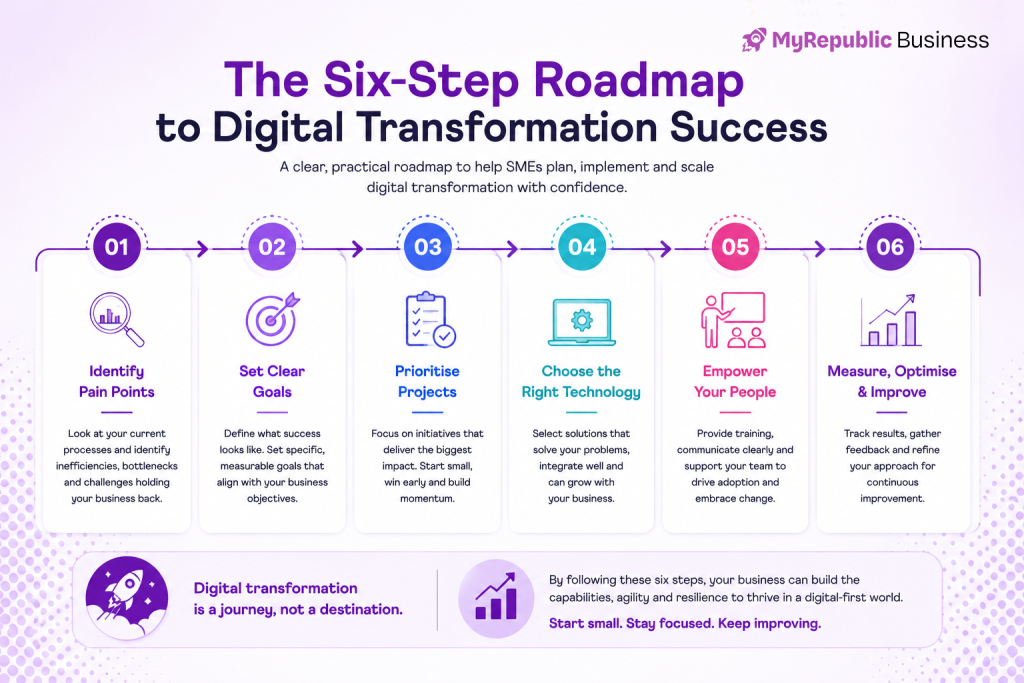
While there’s no one-size-fits-all approach to digital transformation, a clear strategy can help businesses avoid costly mistakes and maximise the value of their technology investments. Rather than trying to digitise everything at once, start by solving your biggest business challenges and build from there. The following six steps provide a practical roadmap for getting started.
Step 1: Identify your biggest business pain points
Technology should solve problems, not create them.
Begin by identifying where your business is losing time, money, or productivity.
Common examples include:
- Manual paperwork
- Duplicate data entry
- Slow approval processes
- Lost customer enquiries
- Poor visibility into operations
- Frequent human error
Speak with employees across different departments to identify inefficiencies and understand where improvements can be made.
Step 2: Set measurable goals
Digital transformation should deliver measurable business outcomes.
Instead of saying, “We want to become more digital,”
Set objectives such as:
- Reduce invoice processing time by 50%
- Decrease customer response time to under one hour
- Reduce manual data entry by 80%
- Increase online sales by 25%
- Improve employee productivity with a task completion rate of 90%
Clear KPIs make success easier to measure.
Step 3: Prioritise high-impact projects
Trying to transform everything at once often leads to project fatigue.
Instead, focus on initiatives that deliver quick wins.
For many SMEs, these include:
- Cloud accounting
- CRM implementation
- Digital document management
- Workflow automation
- Business broadband upgrades
Early successes build momentum and confidence for larger transformation initiatives.
Step 4: Choose technology that grows with your business
Not every software platform is suitable for every business.
When evaluating technology, consider:
- Scalability: Can the solution support future growth?
- Ease of use: Will employees actually use it?
- Integration: Can it connect with your existing systems?
- Security: Does it meet modern cybersecurity standards?
- Vendor support: Is reliable technical support available when needed?
Selecting technology based solely on price often becomes more expensive over time.
Step 5: Invest in your people
One of the biggest reasons digital transformation projects fail is poor user adoption rather than the technology itself.
Employees need the right training, clear communication, and ongoing support to feel confident using new systems. Giving staff opportunities to ask questions and provide feedback throughout the implementation process also helps increase adoption, minimise disruption, and maximise the return on your technology investment.
When staff understand how new systems make their work easier, adoption rates improve significantly.
Business leaders should also demonstrate commitment by actively using new processes and encouraging continuous learning.
Step 6: Measure, review and improve
Digital transformation is an ongoing journey rather than a one-time project.
Regularly review KPIs such as:
- Productivity improvements
- Customer satisfaction
- System adoption
- Operational costs
- Employee feedback
- Revenue growth
Continuous optimisation helps ensure your technology continues to deliver value as your business evolves.
Common digital transformation challenges
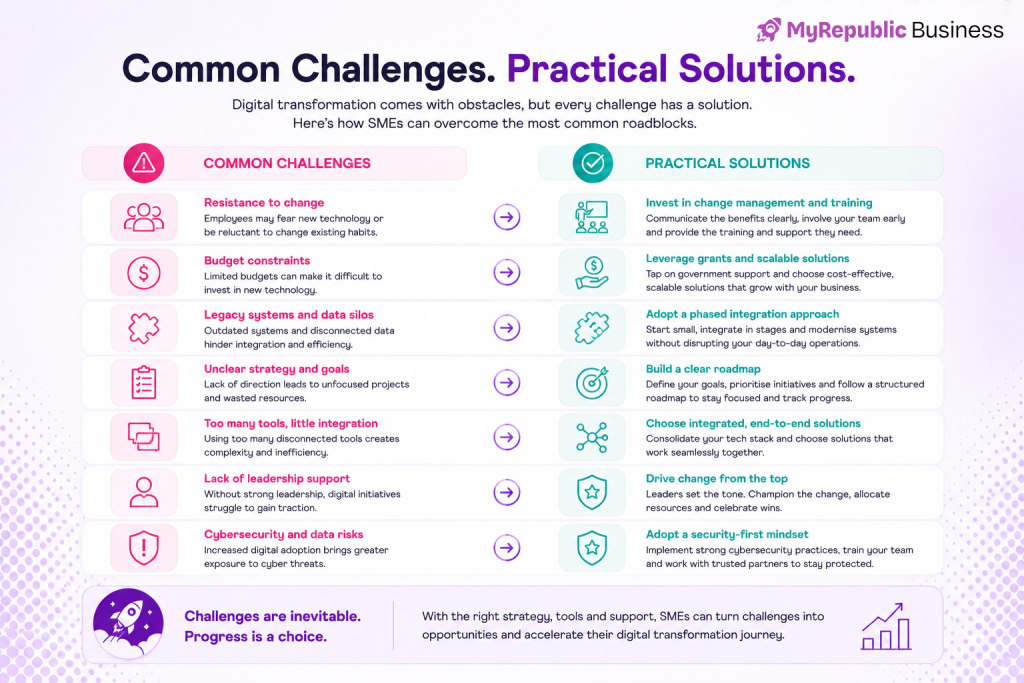
Even well-planned projects encounter obstacles. Understanding common challenges helps businesses prepare for them.
Many projects encounter obstacles because businesses underestimate the scale of organisational change involved, prioritise technology over people, or fail to develop a clear implementation strategy. Recognising these common pitfalls early can help SMEs avoid costly mistakes, improve adoption, and maximise the return on their digital investments.
Resistance to change
Employees may worry that technology will replace their roles or disrupt familiar ways of working.
Involving staff early, communicating the benefits clearly, and providing adequate training can help build trust and encourage adoption.
Budget constraints
Many SMEs operate with limited technology budgets.
Prioritising projects with a clear return on investment (ROI) and taking advantage of available government grants can help reduce financial pressure.
Legacy systems
Older software may not integrate well with modern cloud platforms.
Businesses should assess whether existing systems remain fit for purpose or require a phased replacement strategy.
Poor planning
Implementing technology without a clear strategy often results in disconnected systems, duplicated work, and wasted investment.
Successful digital transformation starts with clear business objectives rather than software demonstrations.
Too many disconnected platforms
Businesses sometimes invest in multiple specialised applications that fail to communicate with one another.
Where possible, prioritise solutions with strong integration capabilities.
Lack of leadership
Digital transformation requires active leadership and organisational commitment.
When business leaders champion change and lead by example, employees are more likely to embrace new ways of working.
Insufficient cybersecurity
Security should never be treated as an afterthought.
Every new digital system expands the potential attack surface, making cybersecurity planning essential from the outset.
Government support available for Singapore SMEs
Singapore offers numerous initiatives to help SMEs accelerate digital transformation, improve productivity, and build long-term capabilities. Whether you’re looking to implement off-the-shelf software, undertake a larger transformation project, or simply need guidance on where to begin, there are government programmes available to support businesses at different stages of their digital transformation journey. The table below summarises some of the key initiatives available to Singapore SMEs.
Productivity Solutions Grant (PSG)
What it supports: Supports the adoption of pre-approved IT solutions and equipment that improve productivity and automate business processes. Eligible SMEs can receive funding support for qualifying solutions.
Who it’s for: SMEs looking to implement ready-to-use digital solutions such as accounting, CRM, HR, or cybersecurity software.
Learn more: Productivity Solutions Grant (PSG)
Enterprise Development Grant (EDG)
What it supports: Supports larger-scale business transformation projects, including innovation, process redesign, capability development, and international expansion. Funding can cover consultancy, software, equipment, and internal manpower costs for qualifying projects.
Who it’s for: Businesses planning strategic transformation initiatives or long-term growth projects.
Learn more: Enterprise Development Grant (EDG)
SMEs Go Digital
What it supports: Provides Industry Digital Plans, pre-approved digital solutions, and practical guidance to help SMEs adopt the right technologies for their sector. Many solutions are eligible for grant support.
Who it’s for: SMEs beginning their digital transformation journey or looking for industry-specific recommendations.
Learn more: SMEs Go Digital
CTO-as-a-Service
What it supports: A complimentary advisory platform that helps SMEs assess their digital readiness, identify suitable technologies, and receive recommendations tailored to their business needs.
Who it’s for: Businesses without an in-house IT or technology team that need guidance before investing in digital solutions.
Learn more: CTO-as-a-Service
Digital transformation technologies worth investing in
Technology investments should always align with business objectives. Rather than following trends or adopting the latest tools for the sake of it, SMEs should focus on technologies that solve real operational challenges and support long-term business growth.
With so many digital solutions available, choosing where to invest can be overwhelming. The following technologies are among the most valuable for Singapore SMEs, along with the business needs they are best suited to address.
Focus area: Build a reliable digital foundation
Technologies: Business Broadband, Cloud Computing, Managed IT Services
Key benefits:
- Enables secure access to systems and data from anywhere
- Supports hybrid and remote working
- Improves business continuity and scalability
- Reduces the burden of managing IT infrastructure
Focus area: Protect your business and data
Technologies: Cybersecurity Backup & Disaster Recovery
Key benefits:
- Safeguards sensitive business and customer information
- Reduces the risk of cyber attacks and data breaches
- Minimises downtime during unexpected incidents
- Strengthens business resilience and compliance
Focus area: Increase productivity and drive growth
Technologies: Artificial Intelligence (AI), Business Analytics, Workflow Automation
Key benefits:
- Automates repetitive tasks and reduces manual work
- Improves customer relationship management
- Connects business systems for better visibility
- Provides insights to support faster, data-driven decisions
- Helps businesses scale more efficiently
How MyRepublic supports SME digital transformation
Successful digital transformation depends on having the right technology partner.
Beyond providing high-speed Business Broadband, MyRepublic helps SMEs build secure, connected, and scalable digital environments that support long-term growth.
From managing day-to-day IT operations to strengthening cybersecurity and enabling cloud adoption, MyRepublic offers a comprehensive range of business solutions designed to simplify technology management and improve operational resilience. Businesses can strengthen their digital capabilities through Managed IT Services that reduce the burden of day-to-day technology management while ensuring systems remain secure and operational.
Cybersecurity solutions protect businesses against evolving cyber threats, while cloud solutions enable secure access to applications and data from virtually anywhere.
For businesses seeking better communication and collaboration, Business Voice solutions support modern hybrid workplaces with flexible telephony services.
MyRepublic also offers Website and Digital Services to help SMEs strengthen their online presence, improve customer engagement and support digital marketing initiatives.
Rather than simply supplying internet connectivity, MyRepublic partners with businesses to create the digital foundation needed for sustainable transformation and future growth.
Digital transformation is no longer a future ambition
It has become a business necessity for Singapore SMEs looking to remain competitive in an increasingly digital economy.
The most successful businesses don’t attempt to transform everything overnight. Instead, they begin by understanding their operational challenges, identifying opportunities to improve productivity and selecting technologies that deliver measurable business outcomes.
Whether it’s automating administrative work, strengthening cybersecurity, improving customer experiences, or enabling hybrid work, every successful transformation starts with a clear strategy supported by the right people, processes, and technology.