
ALERT: Stay vigilant against online scams. Never share passwords, banking details, personal information, or OTPs through unsolicited communications. Only enter OTPs on trusted platforms for transactions or authentication you initiate.
ALERT: Our Privacy Policy has been updated to reflect regulatory requirements relating to SIM registration data.

Can Quantum Computers Break Your Wi-Fi?

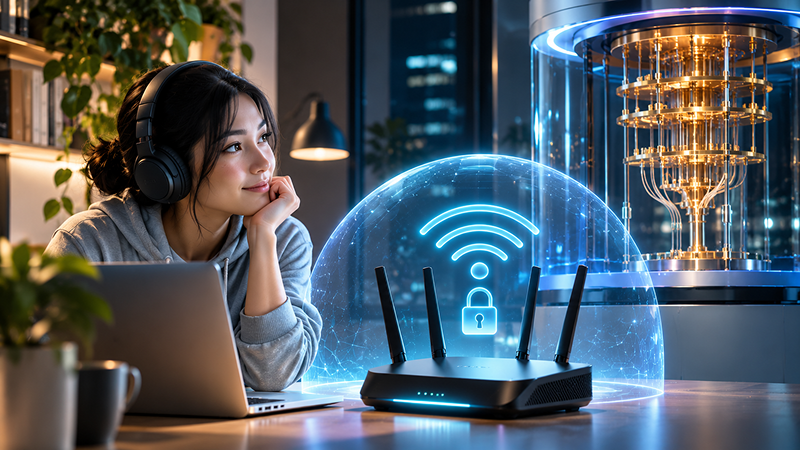
woman at desk with laptop computer and Wi-Fi router with symbols representing security in a post quantum world

Imagine a computer so powerful that it could crack security systems that would take today’s computers an almost unimaginable amount of time to break.

Sounds like something out of a sci-fi movie, right?

Well, quantum computers are real. And while they’re still far from reaching their full potential, scientists are already preparing for a future where they could challenge some of the encryption technologies protecting our digital lives.

That raises an interesting question: Could a quantum computer eventually break into your home Wi-Fi?

The short answer? Potentially, quantum computing could threaten certain parts of Wi-Fi security in the future. But your home network isn’t about to be hacked by a quantum computer tomorrow.

Here’s what’s happening, why it matters and how the next generation of Wi-Fi security is already taking shape.

First, What Exactly Is a Quantum Computer?

Your everyday computer, smartphone and gaming PC all process information using bits. Each bit represents either a 0 or a 1.

Quantum computers work differently.

They use something called qubits, which can exist in combinations of 0 and 1 through a quantum property known as superposition. Together with other quantum effects, this allows quantum computers to approach certain calculations in ways that traditional computers cannot.

But that doesn’t mean a quantum computer is simply a supercharged gaming PC.

In fact, quantum computers aren’t necessarily faster at everyday tasks like browsing the internet, streaming videos or playing games.

Their potential advantage lies in solving particular types of complex problems, including some mathematical problems that underpin modern encryption.

And that’s where Wi-Fi security enters the picture.

How Does Your Home Wi-Fi Stay Secure?

When you connect your phone, laptop or smart TV to your home Wi-Fi, your router uses security protocols to help protect the connection.

You might have seen terms such as WPA2 and WPA3 in your router settings.

These are Wi-Fi security standards designed to prevent unauthorised access and protect information travelling over your wireless network.

Think of Wi-Fi encryption as putting your data inside a locked box before sending it across the room.

Someone nearby might be able to detect the wireless signals, but encryption helps prevent them from reading the information inside.

WPA2 vs WPA3: What's the Difference?

WPA2 has been widely used for years and remains common across home networks. It uses strong encryption, although its security also depends on factors such as password strength and correct configuration.

WPA3 is a newer generation of Wi-Fi security that improves protection in several areas, including how devices authenticate when connecting to a password-protected network.

For example, WPA3-Personal uses a technology called Simultaneous Authentication of Equals (SAE), which provides stronger protection against certain password-guessing attacks than WPA2-Personal.

However, even WPA3 wasn’t originally designed around every possible threat posed by future quantum computers.

That’s why researchers are looking ahead.

So, Can Quantum Computers Actually Crack Wi-Fi Encryption?

Here’s where things get interesting.

Not all encryption works the same way, and quantum computers don’t threaten every security technology equally.

There are two important categories to understand.
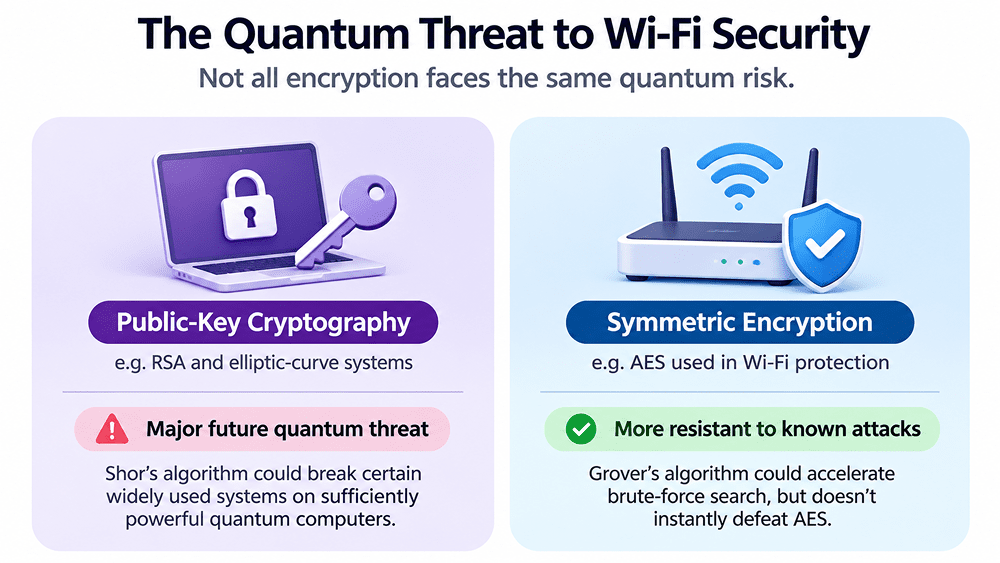
comparison of different types of wi-fi encryption to better understand quantum concerns for security

1. Public-Key Cryptography: The Bigger Quantum Concern

Public-key cryptography is used throughout the internet for tasks such as establishing secure connections and verifying digital identities.

Many widely used public-key algorithms rely on mathematical problems that conventional computers find extremely difficult to solve.

A sufficiently powerful quantum computer running an algorithm known as Shor’s algorithm could potentially solve certain problems much more efficiently.

This threatens cryptographic systems such as RSA and elliptic-curve cryptography.

These technologies are widely used in digital communications, including some enterprise authentication systems.

2. Symmetric Encryption: A Different Story

Home Wi-Fi networks commonly use AES, a form of symmetric encryption, to protect wireless traffic.

Unlike some public-key systems, AES isn’t simply defeated by Shor’s algorithm.

Another quantum algorithm, known as Grover’s algorithm, could theoretically accelerate certain brute-force searches. However, that doesn’t mean a quantum computer could instantly decrypt AES-protected Wi-Fi traffic.

Strong symmetric encryption remains considerably more resistant to known quantum attacks than many traditional public-key systems.

The important distinction: Quantum computers could eventually threaten parts of the cryptography used to establish and authenticate secure connections. That is not the same as saying they can automatically crack every WPA2 or WPA3 home network.

Is Your Home Wi-Fi at Risk Right Now?

For the average household in Singapore, quantum computing isn’t an immediate Wi-Fi security threat.

Today’s quantum computers face major technical limitations, including hardware errors, limited usable computational resources and the difficulty of scaling systems to perform large, reliable calculations. 

There is currently no demonstrated quantum computer capable of practically breaking the strong cryptography protecting ordinary home Wi-Fi networks at scale.

In the meantime, much more familiar cybersecurity risks deserve your attention.

Weak Wi-Fi passwords, outdated router firmware, insecure smart-home devices and poorly configured networks are far more realistic concerns.

For example, a smart camera with an easily guessed password could provide an attacker with an opportunity long before quantum computing becomes relevant.

So while quantum security is worth understanding, there’s no reason to panic about your home Wi-Fi today.

What Is Post-Quantum Wi-Fi Security?
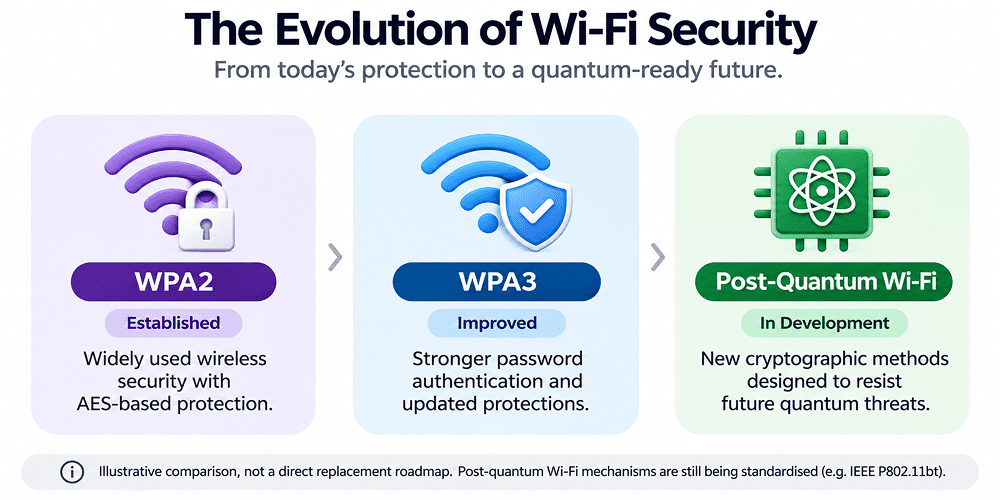
Understand the difference between WPA2 vs WPA3 vs Post Quantum Security and how it affects your Wi-Fi

If quantum computers could eventually threaten existing cryptographic systems, how do we prepare?

The answer is post-quantum cryptography, often shortened to PQC.

Despite its futuristic name, post-quantum cryptography doesn’t require a quantum computer.

It uses new cryptographic algorithms designed to run on ordinary devices while resisting attacks from both conventional and future quantum computers.

In August 2024, the US National Institute of Standards and Technology (NIST) finalised its first three major post-quantum cryptography standards. These include algorithms for securely establishing shared secrets and verifying digital signatures.

The goal is to help protect digital communications before sufficiently powerful quantum computers become available.

IEEE Is Already Developing Post-Quantum Wi-Fi

Here’s the especially interesting part: work on quantum-resistant Wi-Fi is already underway.

The IEEE 802.11 working group, responsible for developing Wi-Fi standards, has been working on IEEE P802.11bt, an amendment focused on post-quantum cryptography.

The proposed changes cover several important areas, including:

By September 2026, the project had progressed through an initial working-group ballot on Draft 1.0.

That doesn’t mean quantum-safe Wi-Fi is already a standard feature in home routers. The specification is still being developed, and its eventual implementation will depend on the final standard and hardware and software support.

Nevertheless, it’s a significant step towards preparing wireless networks for the quantum era.

Will You Need a New Router for Quantum-Safe Wi-Fi?

Possibly, but it’s too early to say.

Future post-quantum security features could require changes to router firmware, device software or hardware capabilities.

Some existing devices may be able to support certain changes through software updates. Others might lack the necessary resources or compatibility. The exact requirements will become clearer as standards are finalised and manufacturers begin implementing them.

For now, there’s no reason to replace a working router simply because you’re worried about quantum computing.

If you’re upgrading your home network, focus on the features that matter today, including strong Wi-Fi security, reliable coverage, device compatibility and performance.

What About Smart Homes and IoT Devices?

Quantum-resistant security could become particularly interesting as our homes get smarter.

Think about how many devices might be connected to a modern home network:

Each device adds another potential point of entry into your home network.

And unlike smartphones or laptops, some smart-home devices may receive limited security updates over their lifetime. That creates a longer-term challenge.

A device purchased today might still be in use years from now, when cybersecurity standards and threats have changed considerably. Post-quantum security could eventually become another consideration in how manufacturers design connected products and how consumers choose devices for their homes.

However, it won’t replace the need for secure software, regular updates and sensible network management

How to Keep Your Wi-Fi Secure Today

While researchers prepare for tomorrow’s threats, there are several practical steps you can take to protect your home network right now.

1. Use WPA3 where supported. WPA3 provides improved security protections compared with older Wi-Fi security protocols. If your devices don’t support it, use WPA2 with AES rather than outdated options such as WEP or WPA.

2. Choose a strong Wi-Fi password. Use a long, unique password that isn’t easily guessed. Avoid personal information or passwords reused across other accounts.

3. Keep your router firmware updated. Manufacturers release firmware updates to fix vulnerabilities, improve stability and address security issues.

4. Secure your smart-home devices. Change default passwords where applicable, install available updates and choose devices from manufacturers with a good record of security support.

5. Use a separate guest or IoT network when appropriate. Keeping less-trusted devices separate from your main computers and personal devices can help limit exposure if something is compromised.

6. Review your router settings occasionally. Disable features you don’t need, check connected devices and make sure your network is using an appropriate security mode.

These steps won’t make your network invincible, but they’ll help protect against threats that are much more relevant today.

The Future of Wi-Fi Security Is Already Being Written

So, can quantum computers break your Wi-Fi?

Not with today’s technology. And even in the future, the answer will depend on the cryptographic systems involved, the capabilities of quantum computers and how wireless security evolves.

What makes this topic exciting isn’t that quantum hackers are about to invade our homes.

It’s that researchers and standards organisations are already preparing for a threat that hasn’t fully arrived.

From Wi-Fi 7 and the development of Wi-Fi 8 to emerging post-quantum security standards, wireless technology continues to evolve in ways that go far beyond faster download speeds.

For now, the best approach is simple: keep your home network secure, stay up to date with new technology and choose broadband and networking equipment that supports your household’s needs.

Because the future of connected homes isn’t just about making everything faster.

It’s also about keeping everything secure.

Privacy Policy

At MyRepublic, we are committed to maintain the security and confidentiality of the personal information held by us. This Privacy Policy (“Policy”) describes how we look after the personal information we obtain or you provide us with when you use our Website ([insert Card Con URL]), attend Card Con, or correspond with us relating to Card Con.

1. Your Privacy

We will take reasonable care to ensure that your personal information is accurate, complete, up-to-date and stored in a secure environment, protected from unauthorised access, modification, loss or disclosure. 

2. Personal Information

a. “Personal Information” refers to your personal particulars obtained by us in the course of our dealings with you. Personal Information collected may include personal contact details, interests, comments and feedback, and communication preferences.

b. We may use “cookies” or other similar tracking technologies (“Cookies”), when you visit our Sites or use our products and services to distinguish you from other users. Through Cookies, it might also include how you use our Website to help us develop and improve our website, including details of your domain name and Internet Protocol (IP) address, operating system, browser version, cookie details, how long you stayed on a page, the route you took to navigate through the pages and the website that you visited prior to accessing our site.

c. We collect your personal information through the following means: 

– From you directly:
1. Data submitted through our web forms (including registration forms)
2. Data collected onsite during our exhibition(s), this includes personal information and activities
3. Data collected by  employees when in direct communication with persons / organisations

– By automated technologies / services, including:
1. Data gathered from services which use IP address to determine where the visitors to our site originate from
2. Information from actions made by an individual in response to direct marketing campaigns, including when an individual opens any emails or follows any links originating from our email communications
3. Information related to website navigation and usage
4. Data used to provide personalised marketing / user experiences while visiting our sites

– From third party sources, including:
1. Personal information or supplementary information from partners who we engage with in joint marketing efforts
2. Public data sources used to supplement or validate our existing datasets
3. Data services / suppliers used to obtain or supplement our existing datasets
4. Data which has been acquired as part of an acquisition or merger

3. How we use Your Personal Information

a. We may collect and use your Personal Information to:
1. Provide you with information and updates relating to Card Con.
2. Respond to you in relation to any enquiries you may have
3. Produce analytics relating to your usage of our products and response to our marketing activities
4. Improving our services and user experience
And where you have opted-in:
5. Deliver targeted promotional messaging relating to our services

c. MyRepublic will not use your Personal Information for any purpose not permitted by law or beyond the stated purpose you have consented to.

d. The Card Con Website contains links to other sites. We are not responsible for the privacy practices or the content of other websites. 

4. Who do we share your Personal Information to

a. Apart from our staff, we may share your personal information with third parties to perform obligations or carry out services to us, related to the provision our products or services to you. Those entities may include:
(i) companies related to us;
(ii) our business partners, marketing partners and authorised service providers;
(iii) our professional advisors; and
(iv) our suppliers.

b. We are required to disclose your Personal Information to the parties described above so that they may carry out their obligations to us, and to you. Our disclosure of your Personal Information may, at times, be subject to their privacy policies. To every extent possible, we require these parties to act consistently with the personal information protections we have put in place.

c. We also reserve the right to disclose your Personal Information to law enforcement agencies, government regulators and our professional advisers, to the extent necessary as required by appliable laws.

d. If you post information on any of our Websites or social media platforms, any information on your post, such as your user name, may be seen by other visitors. 

5. How long do we retain your Personal Information

We retain your Personal Information for as long as it is necessary to fulfil the purposes outlined in this Privacy Policy, for legal or business purposes of MyRepublic, or as required or allowed by law. We will cease to retain such Personal Data when it is no longer required for the foregoing purposes. 

6. How you can access and update your Personal Information

a. You must ensure your listed customer details are current, complete and accurate. You may correct or update your customer details by contacting our Customer Support.

b. If you require access or a copy of your Personal Information within our possession, please contact us according to Clause 11 and we will assess your request. In some cases, we may impose a reasonable charge for making copies of Personal Information available to you. If so, we will advise you of the charge prior to making the information available to you. 

7. Withdrawing your Consent

a. You may request to withdraw your consent by contacting us according to Clause 11. Your request for withdrawal of consent will take effect within 30 days upon receipt of your request. Please note that use of your personal data may be essential for us to provide the product or service that you subscribed. Therefore, your withdrawal of consent may impair our ability to continue providing the product or service to you. Your withdrawal of consent does not affect our right to continue to collect, use and disclose personal data where permitted or required under applicable laws.

b. If you wish to withdraw your consent to receive marketing messages about our exclusive offers from us or our business partners, please contact our Customer Support or unsubscribe from our newsletter. Your request will be processed within 30 days. Non-marketing messages including product and service updates and notices will not be affected by your consent withdrawal. 

8. Protecting Your Personal Data

We take reasonable physical, technical and administrative steps to help prevent loss, misuse, unauthorised access, disclosure or modification of Personal Information. However, please understand that the transmission of data over the Internet or any other public network may be subject to loss, interception and misuse. We do not represent, warrant or undertake that your Personal Information transmitted through online means will remain secure, and disclaim all liability arising from such transmission. 

9. Overseas Transfers

We will take all steps reasonably necessary to ensure that your personal information is treated securely and in accordance with this Policy and the data protection legislation when it is processed in, or otherwise accessed from, a location outside Singapore. In order to ensure the highest level of protection. MyRepublic abides by PDPA data standards. 

10. Cookies

a. Cookies helps us to provide you with a better customer experience, when browsing our Sites. Cookies are small data files and may contain unique identifiers stored on your device by an online site. When you use our Site, we may collect standard information that is sent from your browser to our Website, including technical and statistical information.

b. You can usually choose to set your browser settings to manage Cookies. If you choose to remove or reject Cookies, you may not be able to access all or parts of our Website or services. 

11. Changes to this Privacy Policy

We may review, amend or update this Privacy Policy from time to time without prior written notice. Updates to the Privacy Policy will be published on this page. We recommend that your review this page periodically for updates. Your continuous use of our Websites, products and services, will be deemed acceptance of any changes or additions to this Privacy Policy. 

12. Contacting Us

If you have any query or feedback regarding this Privacy Policy, you may contact our Data Protection Officer at: [email protected].

Last updated 26 March 2025 

Card Con – Visitor Terms and Conditions

By registering for Card Con, you acknowledge that you have read, understood, and agree to these Terms and Conditions.

1. Introduction

1.1 These Terms and Conditions (“Terms“) govern the registration and participation of attendees (“Attendees“) in Card Con by MyRepublic (“Card Con“), organised by MyRepublic (“Organiser“).

1.2 By registering for Card Con, Participants agree to comply with these Terms and the Card Con Privacy Policy.

2. Registration

2.1 Registration for Card Coins free of charge.

2.2 Attendees must provide accurate and complete information during the online registrationon the Card Con website at https://myrepublic.net/sg/card-con/ (“Website”) and must present their QR code upon registration at Card Con.

2.3 MyRepublic reserves the right to refuse or revoke an Attendee’s registration at its sole discretion.

3. Event Conduct

3.1 Attendees shall conduct themselves respectfully and follow all rules set by the Organiser.

3.2 Any disruptive, illegal, or inappropriate behaviour, including but not limited to harassment, cheating or other misconduct, may result in immediate removal from the Event.

3.3 Attendees must adhere to all venue rules and regulations.

4. Intellectual Property

4.1 Attendees shall not infringe on any third-party intellectual property rights during Card Con.

4.2 Unauthorised reproduction, distribution, or possession of copyrighted or trademarked materials is strictly prohibited.

4.3 The Organiser may take appropriate action against any Attendeefound violating intellectual property laws, including but not limited to removal from Card Con.

4.4 The Organiser disclaims all liability to the Attendees and any third parties for the infringement of laws, regulations, intellectual property rights, and venue requirements by the exhibitors, vendors and Attendees.

5. Liability Disclaimer

5.1 Subject to applicable law, the Organiser, the venue, the vendor, and the exhibitors disclaim all liability for any injury, damage or loss of any kind, including but not limited to personal injury, loss, or damage to property suffered by Attendees during the Event, even if it is caused by the negligence, omission, or fault of the Organiser, its employees, officers, agents, or sub-contractors in connection with the Website, or Card Con.

5.2 The Organiser shall not be responsible for any disputes, damages, or losses arising from transactions or interactions between Attendees, or between Attendees and the exhibitors at Card Con.

5.3 Attendees attend Card Con at their own risk and are responsible for their own personal belongings.

6. Photography and Media Release

6.1 The Organiser may take photographs, videos, or other recordings during Card Confor promotional purposes.

6.2 By attending Card Con, Attendeesconsent to the use of their likeness in such media without compensation.

7. Tournament & Prize Terms (If Applicable)

7.1 Tournament participants must follow official tournament rules and regulations.

7.2 Prizes are non-transferable, and non-exchangeable.

7.3 Any disputes will be resolved by the Organiser or its appointed vendors, and their decision will be final.

8. Amendments and Cancellation

8.1 The Organiser reserves the right to amend these Terms at any time without prior notice.

8.2 The Organiser may cancel, postpone, or modify Card Conat its sole discretion without liability.

9. Governing Law

9.1 These Terms shall be governed and construed in accordance with the laws of Singapore.

9.2 Any disputes arising from or related to these Terms shall be subject to the exclusive jurisdiction of the courts of Singapore.